Around a month ago, the team made a post on bookface regarding "pivot hell".
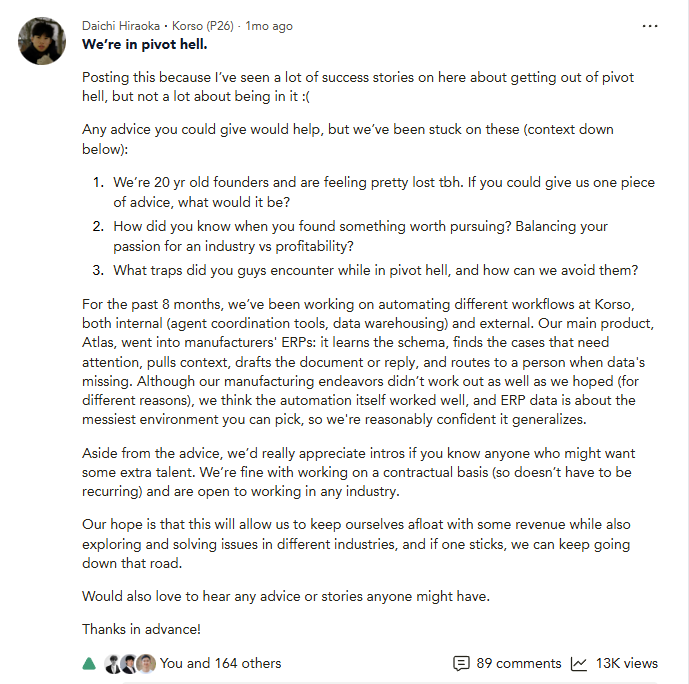
It went pretty viral, and we ended up getting so much support from founders who had been through the same thing (so glad for the YC community). Since we received such good advice, I wanted to collect it in case it helps someone else. However, I will say that since there are infinite ways out of pivot hell, a lot of the advice that we received conflicted with each other. Take everything with a grain of salt - see what you can apply to your situation
I think the most common advice we received was to take a break. At first, it sounded almost too simple. When you've spent months trying things and none of them are working, it feels as though the answer must be to work harder. Coupled with the culture of large raises and flashy announcements that plague LinkedIn nowadays, you feel even more pressure to continue working. An accelerator like YC can make that feeling even stronger since everyone around you is building, talking to users, and reporting progress.
At the time, taking two weeks off seems like the last thing a startup should do. And yet, we took the advice anyway. The team went to Chile for two weeks to let ourselves reset. In hindsight, this was probably the best thing we could have done. Mental clarity is one of the most important aspects for a founder, and while I can't prove the trip caused it, we soon found the idea we wanted to work on.
After that, the advice split into two broad camps. One was to move fast: run weekly sprints, try an idea, talk to potential customers, and see if anyone will buy before investing much time in building. For example: you pick an idea on Monday, build a first version on Tuesday, spend Wednesday trying to sell it, and by Thursday decide whether to keep going. It sounds intense, but a company has to sell something and a short sprint is the easiest way to prove it.
The other half thought we should slow down a bit. Choose a sector, study it deeply, and give ourselves enough time to truly become domain experts. Only then will we notice problems that were not obvious from the outside. Even if that search doesn't produce a company immediately, we would come away having learned so much.
I don't think these approaches cancel each other out. Sprints are useful when you have a specific hypothesis that customers can quickly confirm or reject. Going deep makes sense when you don't yet understand the field well enough to form a good hypothesis. Our mistake in manufacturing was to do neither particularly well: we spent a long time building, but not enough time learning from the people who would use the product.
Another theme was that the work should be something you actually enjoy doing. Personally, I believe this is extremely important. While this advice may not apply as much if you're under immediate financial pressure and needing to optimize for finding revenue quickly. But if you have the room to choose, it matters a lot whether you actually care about the problem you're tackling. A lot of founders arrive at YC with an idea they think could be a great company, without asking whether it is something they would actually want to work on for the next decade.
It is easy to get pulled toward what a founder is supposed to want: a big round, a huge market, a certain ARR number. The forum talked about this one quote Michael Seibel said:
“Find something to do that you'd be happy to fail at for a year or longer because you'd enjoy working on it anyway. If you can't do something for at least a year, you'll never get anywhere regardless.”
And he makes a great point. If you enjoy the industry and the problems in it, you can keep trying long enough to find something. If you don't, each setback feels like a reason to leave. Enjoying the work also means enjoying what the company actually does every day. One person described running a business that sold to local restaurants. The work was cold calls, driving around, and giving in-person demos. They didn't like doing any of it. Their pivot, consumer electronics company, meant making social media content, working with creators, designing in CAD, and sourcing components. The two ideas might look equally exciting in a pitch, but they produce completely different lives for their founders. He certainly enjoyed the second more.
The same goes for customers. Someone asked us whether we would want to be friends with the people we were building for. You don't have to literally be friends with every customer, but you will spend a lot of time with them. In manufacturing, we were mostly approaching strangers. Our friends and close acquaintances weren't from that world, so even casual feedback was hard to get. With the idea we eventually chose, we can see our friends using it, hear what frustrates them, and understand their problems without routing everything through a sales call.
There was also disagreement about how big an idea should be at the start. Some founders suggested finding a narrow problem and getting a few customers. Others said a niche isn't worth pursuing unless you can already see a path to a company making more than $100 million ARR. Without that path, they argued, you might do just as well financially by taking a job.
I think both approaches are valid. There's nothing wrong with starting with a small problem you can actually solve. A few customers can teach you more than a large market because you get to discover a path from the small problem to a much bigger one. Of course, this depends on the industry, and not every niche grows into a large company. But I don't think you need to know the final size of the business before you're allowed to start.
A related trap is caring too much about your company's history. Founders sometimes act as though the first launch has to be perfect, because otherwise people will remember it forever. In reality, most people pay far less attention to your earlier attempts than you do. Cursor explored other directions before it found what worked, and plenty of other companies did too. The launch gives you something real to learn from, and you really don't know what's going to happen until you do.
Of course, launching and learning doesn't tell you exactly when to pivot. Stay with a problem long enough and you may stumble onto the version of it that people really want. Similarly, leave too early and you'll never find it. I don't know a rule that tells you where the line is - it's something that you just have to guess at.
Looking back, starting a startup has been the single most challenging thing I have ever done. There's no obvious path, and no guarantee that the next attempt will work. You're literally just poking around in the dark until something sort of sticks, and even then there's nothing really telling you what direction to take. Startup culture makes it easy to measure yourself by how much you've raised or how fast you're growing, which can make asking for help feel like an admission of failure. But the response to our post reminded me how many founders have felt just as lost. If you're in that place now, I hope some of this advice helps. Don't be afraid to reach out to the people around you. And if you've made it through pivot hell yourself, share what helped you; it might be exactly what someone else needs to hear.